


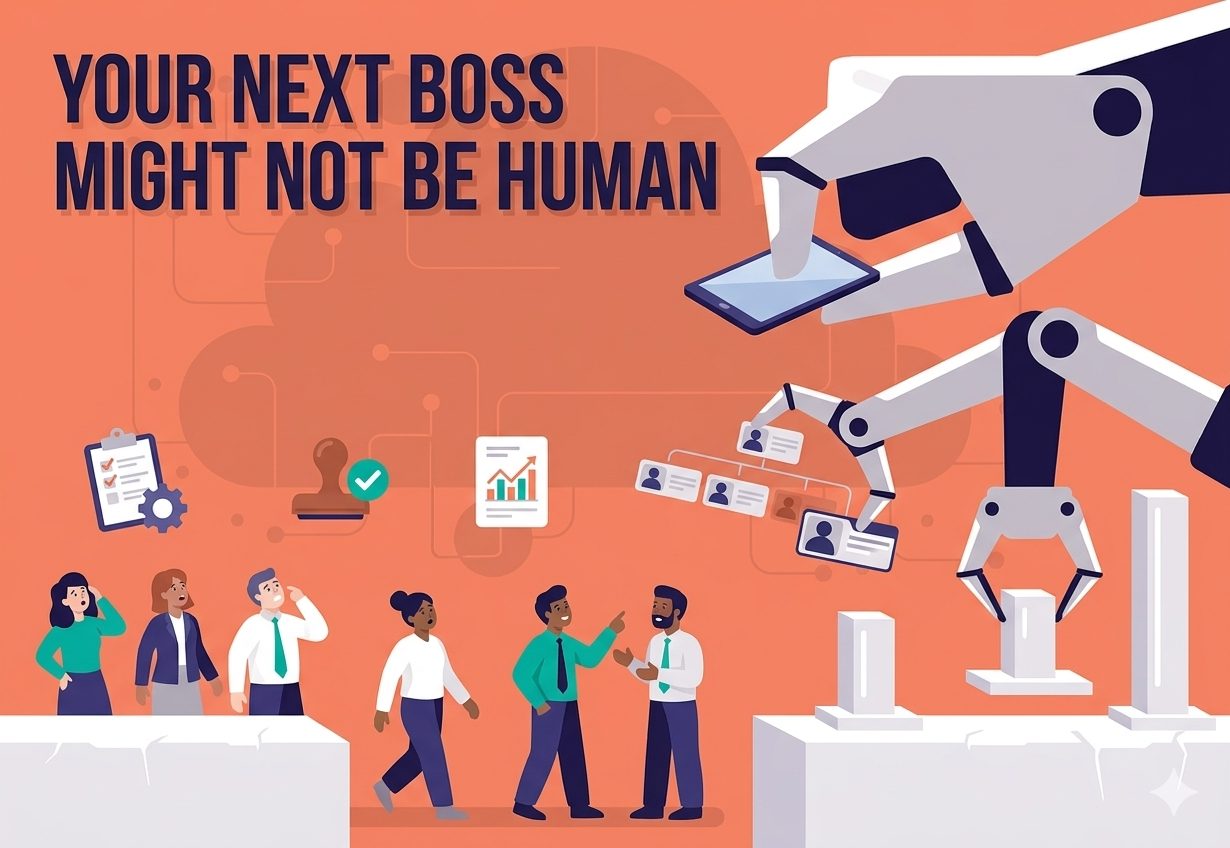
AI Bosses Are Coming: What It Means for Business Owners and How to Stay Ahead
The idea of having an AI as your boss might sound futuristic.
But it’s already starting to happen.
A recent Quinnipiac University poll revealed that 15% of Americans are open to working under an AI manager — a system that assigns tasks, manages schedules, and makes decisions.
At the same time, 70% believe AI will reduce job opportunities.
So, what does this mean for business owners, startup founders, and decision-makers?
The Real Shift: From Automation to Decision-Making
AI is no longer limited to chatbots or simple automation.
Companies are now using AI to:
- Assign and prioritize tasks
- Approve workflows (like expense reports)
- Analyze performance and optimize operations
- Replace layers of middle management
Organizations like Amazon, Workday, and Uber are already experimenting with these models.
This trend is often called “The Great Flattening” — fewer managers, faster execution, and more automated decision-making.
What This Means for Your Business
This shift is not about replacing people overnight.
It’s about removing inefficiencies.
Businesses that rely heavily on manual processes, approvals, and disconnected tools will struggle to keep up.
On the other hand, companies that build smart systems will:
- Operate faster with fewer bottlenecks
- Reduce dependency on manual oversight
- Scale without increasing team size proportionally
- Make better, data-driven decisions
How Smart Companies Are Adapting
From what we’re seeing in real-world projects, the approach is changing:
Instead of hiring more people → businesses are building systems
Instead of manual approvals → AI-driven workflows
Instead of multiple tools → unified platforms
This is where custom-built solutions play a critical role.
What We’re Actually Building for Clients
At Walking Dreamz Technologies, we work closely with businesses to implement practical, scalable solutions — not just ideas.
Some recent implementations include:
1. AI-Powered Workflow Automation
Systems that automatically assign tasks, manage approvals, and generate reports — reducing the need for constant supervision.
2. Custom SaaS Platforms
Replacing multiple third-party tools with a single platform tailored to business needs, improving efficiency and reducing costs.
3. Scalable Backend Systems
Using technologies like MERN and Golang to handle high-volume operations with minimal human intervention.
These are not experimental projects — they are live systems solving real business problems.
The Biggest Misconception About AI
Many businesses think adopting AI means adding new tools.
That’s not true.
The real value comes from rethinking how your business operates.
AI is not just a feature.
It’s a structural change.
Final Thought
AI won’t replace your business.
But it will expose inefficiencies inside it.
The companies that succeed will not be the ones using the most tools…
They will be the ones building the smartest systems.
Want to Explore This for Your Business?
If you’re considering automation, AI integration, or building custom systems to scale your operations, it’s worth evaluating where your current processes can be optimized.
Sometimes, a few smart changes can replace months of manual work.
